Key takeaways
- Jackery and Anker list 0 °C as the lowest charging temperature for their 1 kWh stations.
- Both can still power devices below freezing: down to -10 °C for the Jackery and -20 °C for the Anker, as listed by the brands.
- Keep the station indoors and run the solar cable to it; the panel can sit in the cold, the battery should not.
- In Ottawa in December, a 200 W panel makes about 0.15 kWh a day flat and about 0.37 kWh tilted steeply, on paper.
In this article
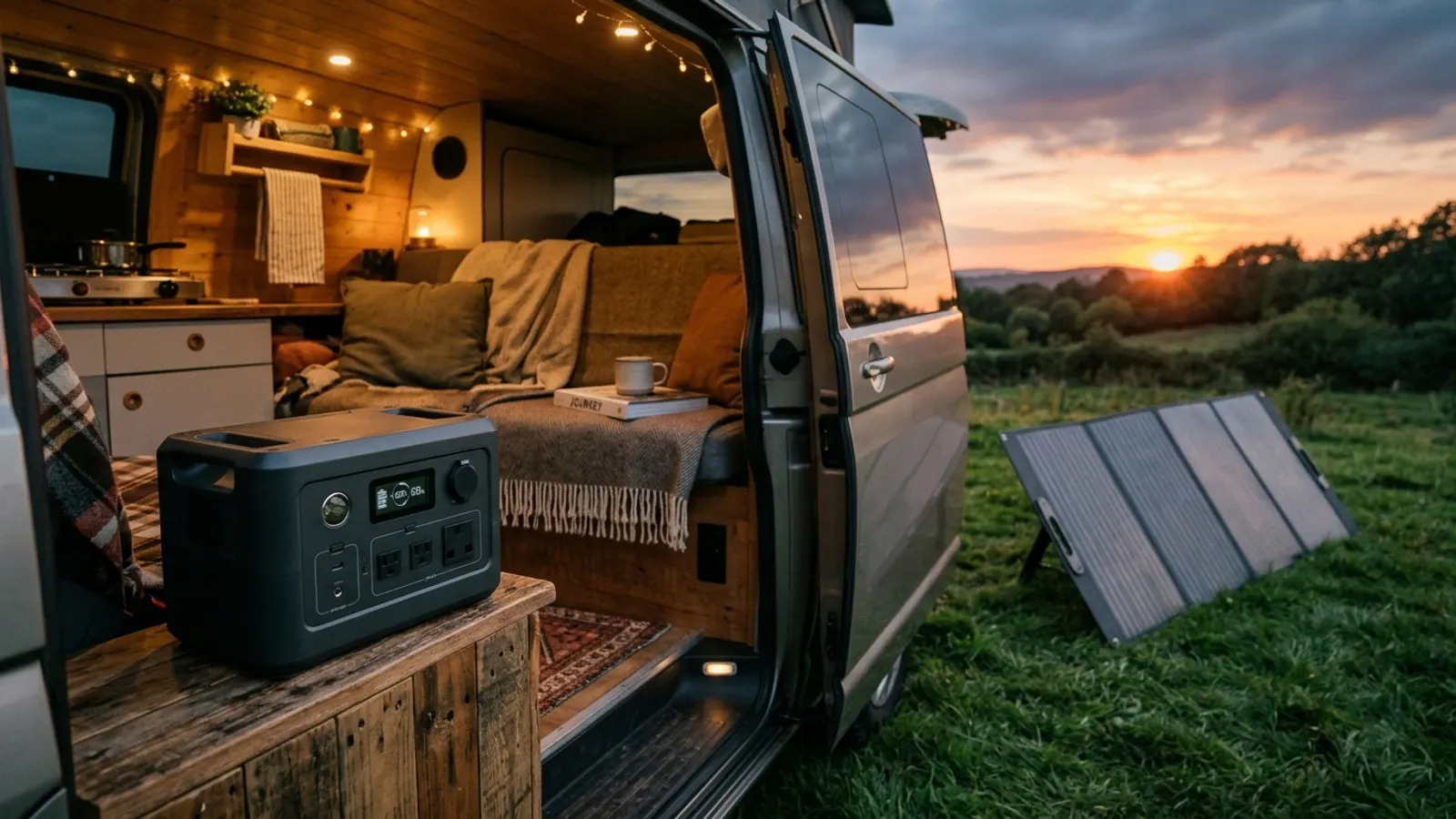
Don’t charge a portable power station below 0 °C. The brands we checked list 0 °C as their lowest charging temperature, even though the same stations can keep powering devices a bit below freezing. In a Canadian winter, the simple rule is: battery inside, panel outside.
What the brands list
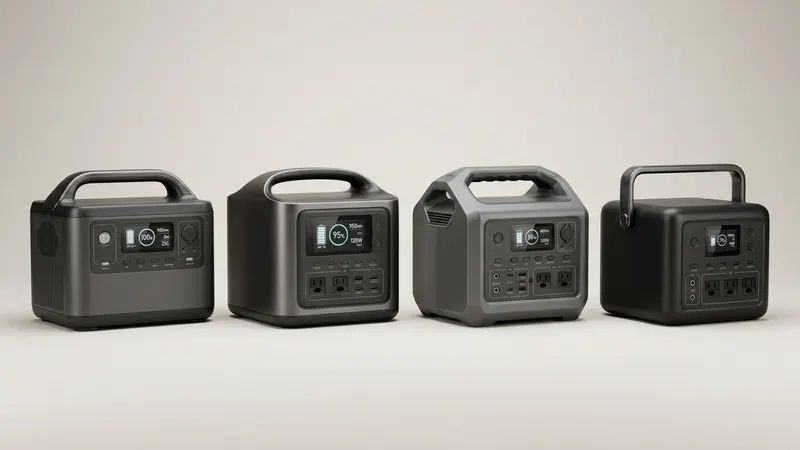
Two common 1 kWh stations publish clear temperature ranges. Here they are, as listed by the brands.
| Station | Charging | Powering devices (discharging) |
|---|---|---|
| Jackery Explorer 1000 v2 | 0 to 45 °C | -10 to 45 °C |
| Anker SOLIX C1000 | 0 to 40 °C (32 to 104 °F) | -20 to 40 °C (-4 to 104 °F) |
Charging means putting energy in, from the wall, the car or a solar panel. Discharging means using it, to run a lamp or a fridge.
Jackery adds that using the unit outside its range may limit its charging and discharging, or stop it from charging or discharging at all. Other brands set their own limits, so check your manual for your exact model.
Why the cold matters for charging
Both stations use LFP batteries (lithium iron phosphate), a type of lithium battery known for long life. Like other lithium batteries, they are sensitive to being charged while cold, and battery makers set a lower limit to protect the cells.
Most stations have a battery management system, a small computer that watches temperature and voltage. If the battery is too cold, it may slow or block charging. That protects the battery, but it also means your solar panel can be in full sun while nothing goes in.
Using a station in the cold is less of a problem, within the listed range. Expect it to deliver less than in summer, though, and keep an eye on the battery level.
Battery inside, panel outside
The fix is easy. Keep the station in a heated room, and bring the energy to it:
- Run the solar panel’s cable through a door or window gap to the station inside. Don’t pinch the cable, and don’t leave a door open in a way that lets heat or snow in.
- If the station was in a cold car or garage, bring it in and let it reach room temperature before you plug it in. A heavy box takes a while to warm up.
- Charge from the wall whenever you can, so the battery is full when an outage starts.
- Keep the station away from wood stoves, baseboards and other heat sources; room temperature is the goal, not hot.
What winter solar actually delivers
Winter sun is weak in Canada, which is the other reason to keep expectations modest. PVGIS, a European Commission solar tool, gives average daily output per 1,000 W of panels in Ottawa. These averages assume the panel is clear of snow.
| Ottawa | Flat panel, kWh per 1,000 W per day | Tilted 60°, kWh per 1,000 W per day | 200 W panel, flat | 200 W panel, tilted 60° |
|---|---|---|---|---|
| December | 0.76 | 1.86 | ≈ 0.15 kWh | ≈ 0.37 kWh |
| January | 1.13 | 2.71 | ≈ 0.23 kWh | ≈ 0.54 kWh |
| July, for comparison | 4.65 | 3.69 | ≈ 0.93 kWh | ≈ 0.74 kWh |
The math: a 200 W panel is 0.2 of 1,000 W, so in December, tilted at 60°, it makes about 0.2 × 1.86 ≈ 0.37 kWh a day. Real output is lower than this on paper figure: snow, frost, shade and short days all cut into it.
Two lessons. Tilt the panel steeply in winter, since the sun is low. And don’t plan on solar to refill a 1,000 Wh station in a December outage; at about 0.37 kWh a day, it would take about three days.
A winter routine that works
Before the cold season
Charge the station to full in a warm room. Check it every month or two and top it up. Make a note of its temperature range on a piece of tape on the case.
During a winter outage
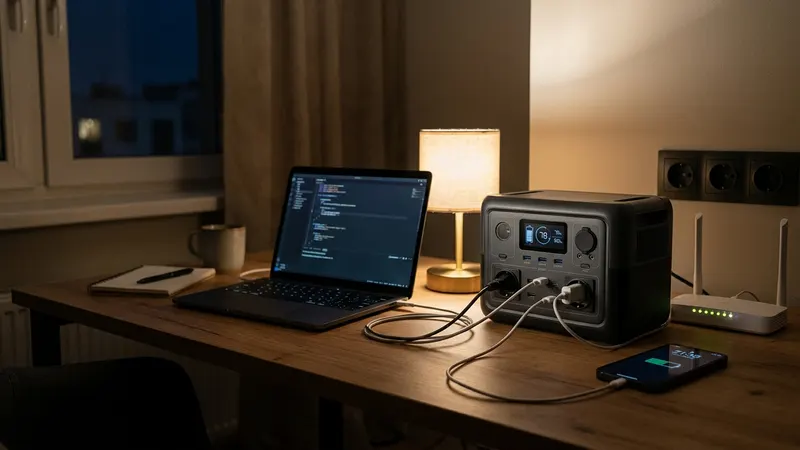
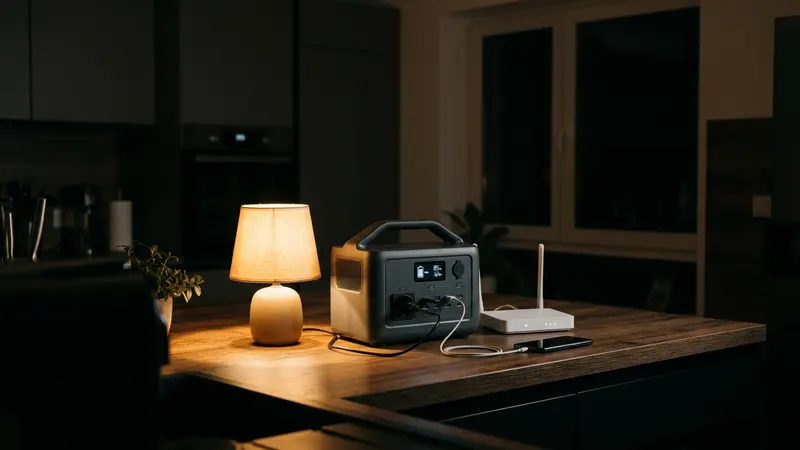
Keep the station in the warmest room where you are staying. Run small loads: a router, a lamp, phones. Each of those uses little energy; on the Anker SOLIX C1000, a 10 W router runs about 1,056 × 0.85 ÷ (10 + 10) ≈ 45 hours on the site’s formula, which includes 10 W for the station’s own use.
For a full list of what a station can and can’t do in a storm, read our post on ice storm outages. To compare temperature specs and solar input across models, see the comparison page, or the Anker SOLIX C1000 page.
At the cottage or in the car
Don’t leave the station in a vehicle or an unheated cottage overnight in winter. Carry it in, warm it up, then charge.
When you arrive at a cold cottage
A winter weekend at the cottage is the classic trap. The station rode in the trunk for three hours, the cottage is cold, and you want to plug in the panel right away.
Do it in this order: power devices from the station first, if it is within its discharging range. Get the cottage warm. Charge the station only once the room, and the box itself, are above 0 °C. If the display shows no charging even in sunshine, the cold is the likely reason, not a broken panel.
In short
- The Jackery Explorer 1000 v2 and Anker SOLIX C1000 list 0 °C as their lowest charging temperature.
- They can still power devices below freezing, down to -10 °C and -20 °C respectively.
- Keep the battery inside and bring the solar cable to it.
- Winter solar is weak: about 0.37 kWh a day from a steep 200 W panel in Ottawa in December.
Sources
- Jackery Canada: Explorer 1000 v2 (charging 0 to 45 °C, discharging -10 to 45 °C)
- Anker: Introduction to Anker SOLIX C1000 (charging 32 to 104 °F, discharging -4 to 104 °F)
- PVGIS (European Commission JRC), NSRDB data, Ottawa, 1 kWp tilted 60°, 14 % losses
- PVGIS (European Commission JRC), NSRDB data, Ottawa, 1 kWp flat, 14 % losses
Questions
What happens if I try to charge a station below 0 °C?
It depends on the model. Jackery says that outside its range the unit may limit charging or discharging, or be unable to do either. Bring it inside and let it warm up first.
Can I use a power station outside in winter?
For powering devices, often yes, within the brand's range: down to -10 °C for the Jackery Explorer 1000 v2 and -20 °C for the Anker SOLIX C1000. Below that, keep it inside.
Can I leave a station in the car or garage overnight?
In a Canadian winter, the car or an unheated garage can drop well below the listed limits. Store the station in a heated room and carry it out when you need it.
Do solar panels work in the cold?
Yes, but days are short and the sun is low. Snow on the panel stops it almost completely, so brush it off.
Stations in this article
- 1056 Wh · 1800 W Anker SOLIX C1000 Every device with the Anker SOLIX C10001,056 Wh Check price
- 1070 Wh · 1500 W Jackery Explorer 1000 v2 Every device with the Jackery Explorer 1000 v21,070 Wh Check price
How much battery do you need?
Tick your devices and how long you need to last. The calculator gives you the answer in 30 seconds.
Open the calculator