Key takeaways
- Two people charging their phones once a day and using a small LED lantern need about 62 Wh a day.
- A station of about 270 to 290 Wh covers that for roughly four days, a typical festival from Thursday to Sunday.
- A 12 V compressor cool box needs about 360 Wh a day, more than a small station holds.
- Check your festival's list of banned items before you pack a station, and keep it shaded and out of sight.
In this article
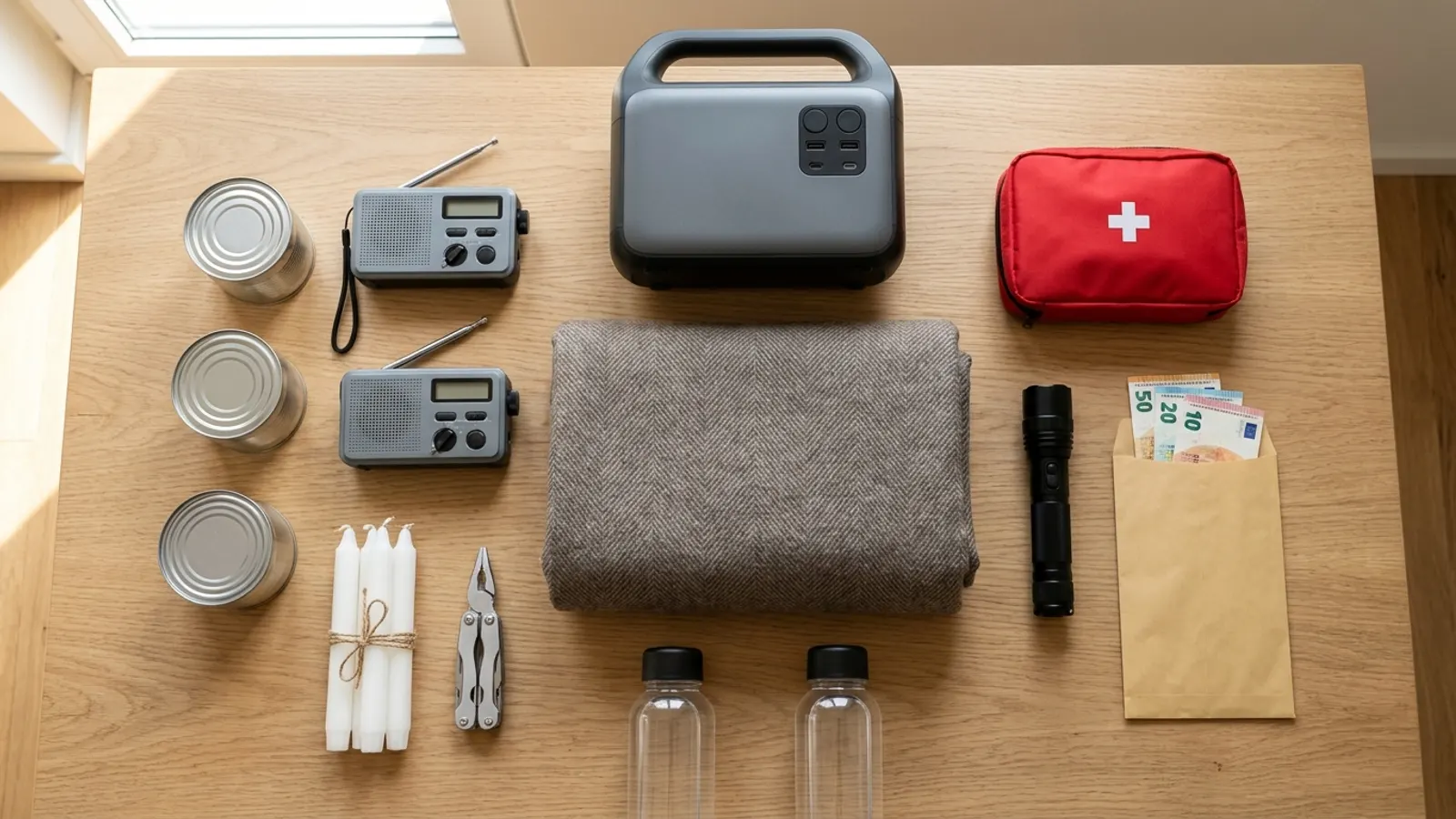
At a festival or on a tent pitch without a hook-up, a small power station of about 100 to 300 Wh is mostly a giant phone charger with a lamp. Around 270 to 290 Wh keeps two people’s phones and a lantern going for four days. It will not run a cool box for the weekend, which is easy to overlook.
What you actually need power for
At a festival the list is short. Phones matter most, for tickets, maps, meeting friends and photos. After that come a light for the tent and maybe a small fan on a hot night.
We use one full phone charge of about 15 Wh, and an LED lamp of 8 W. A daily budget for two people looks like this:
| Item | Energy | Per day |
|---|---|---|
| Phone, person 1 (one full charge) | 15 Wh | 15 Wh |
| Phone, person 2 (one full charge) | 15 Wh | 15 Wh |
| LED lantern, 8 W for 4 hours | 8 × 4 | 32 Wh |
| Total | 62 Wh |
Over four days, Thursday to Sunday, that is 62 × 4 = 248 Wh. Since about 85% of a battery is usable, you need 248 ÷ 0.85 ≈ 292 Wh of battery.
All of this runs from USB ports, so the station does not need its 230 V sockets on. That saves the 10 W or so the station uses to make mains power, which on a small battery makes a big difference.
How long three small stations last
Our rule for USB use is days = battery Wh × 0.85 ÷ Wh per day. Battery sizes are as announced by each brand.
| Station | Usable Wh | Phone charges (15 Wh) | Days for two people (62 Wh) | Days for four people (92 Wh) |
|---|---|---|---|---|
| Jackery Explorer 300 Plus (288 Wh) | ≈ 245 Wh | ≈ 16 | ≈ 3.9 | ≈ 2.7 |
| BLUETTI EB3A (268 Wh) | ≈ 228 Wh | ≈ 15 | ≈ 3.7 | ≈ 2.5 |
| Jackery Explorer 100 Plus (99 Wh) | ≈ 84 Wh | ≈ 5 | ≈ 1.4 | ≈ 0.9 |
To check the first line: 288 × 0.85 = 244.8 Wh, and 244.8 ÷ 62 ≈ 3.9 days. Four people means four phone charges plus the lantern: 4 × 15 + 32 = 92 Wh a day.
The Jackery Explorer 100 Plus has no 230 V socket at all. It is the smallest of the three, and fine for a single night or one person. See how many phone charges each size gives on the phone runtime page for the Jackery Explorer 300 Plus.
What does not fit in a small station
A cool box
A compressor cool box uses more than everything else on this page. Dometic gives 0.98 Ah per hour at 12 V for its CFX3 35, about 12 W on average in 32 °C heat. We count 15 W for a warm tent and a lid that keeps opening, so 15 × 24 = 360 Wh a day.
That is more than any of these three stations holds. A 288 Wh station runs it for about 244.8 ÷ 15 ≈ 16 hours from the 12 V socket. For cold drinks, use ice packs, or look at a station of around 1,000 Wh.
A fan through the night
A small fan uses about 40 W on our figures, through the 230 V socket. Add the station’s own 10 W: the EB3A gives about 227.8 ÷ 50 ≈ 4.6 hours. A USB fan uses much less, so check its label.
Anything that heats
Kettles and heaters draw far more than a small station can give. A kettle is about 2,000 W on our figures, far above what small stations announce for their sockets: 300 W for the Explorer 300 Plus and 600 W for the EB3A.
Try your own list in the runtime calculator.
Adding a solar panel
A folding panel can top the station up during the day. The European Commission’s PVGIS tool gives the average daily output for a panel lying flat, after typical losses. In June, that is about 3.98 kWh per kW of panels near Birmingham and about 4.37 kWh in Cornwall.
So a 100 W panel gives about 3.98 × 100 ≈ 400 Wh a day on average in a Midlands June. That would cover the two-person budget several times over. Real days vary a lot: cloud, rain and a panel left in the shade of the tent cut the output well below that. The panel’s watt rating is a best case, not a daily promise.
Check that the panel’s plug and voltage match the station. BLUETTI announces 200 W of solar input for the EB3A. To compare it with the Jackery, see BLUETTI EB3A vs Jackery Explorer 300 Plus.
Practical tips for the campsite
Check the rules first
Festivals publish their own lists of banned items, and they change from year to year. Look for anything about generators, gas and batteries before you pack.
Keep it cool and hidden
Batteries do not like heat. Keep the station in the shade, not in a closed tent in full sun or on a hot car dashboard. Out of sight in a bag also means it is less likely to walk off.
Arrive full
Charge the station, your phones and any power banks fully at home. Everything you bring full is energy you do not need to find on site.
Weight
The brands announce 3.75 kg for the Jackery Explorer 300 Plus and 4.6 kg for the BLUETTI EB3A. That is fine from the car park, but notice it on a long walk to the campsite.
In short
- Two people with phones and a lantern need about 62 Wh a day, so roughly 290 Wh of battery for four days.
- A 268 to 288 Wh station covers that; a 99 Wh one covers a night or one person.
- A cool box needs about 360 Wh a day and empties a small station in well under a day.
- A 100 W panel averages about 400 Wh a day in June, but much less in poor weather.
Sources
Questions
How many phone charges does a 300 Wh power station give?
A full phone charge is about 15 Wh on our figures. A 288 Wh station gives about 288 × 0.85 ÷ 15 ≈ 16 charges over USB, more for small phones and fewer for big ones.
Can a small power station run a cool box all weekend?
Not on its own. A compressor cool box uses about 15 W on average, so 360 Wh a day. A 288 Wh station runs it for about 16 hours.
Is a power station allowed at festivals?
Rules differ from one festival to the next, and many publish a list of banned items. Check it before you go, especially for generators, gas and large batteries.
Will a solar panel keep it charged at a festival?
It helps on sunny days. In June, EU PVGIS data gives about 400 Wh a day on average for a 100 W panel lying flat in the Midlands, but a grey weekend gives far less.
Stations in this article
- 288 Wh · 300 W Jackery Explorer 300 Plus Every device with the Jackery Explorer 300 Plus288 Wh Check price
- 268 Wh · 600 W BLUETTI EB3A Every device with the BLUETTI EB3A268 Wh Check price
- 99 Wh · 0 W Jackery Explorer 100 Plus Every device with the Jackery Explorer 100 Plus99 Wh Check price
How much battery do you need?
Tick your devices and how long you need to last. The calculator gives you the answer in 30 seconds.
Open the calculator