Key takeaways
- ResMed measured about 7 Wh per hour for an AirSense 10 alone, 22 Wh with the humidifier and 34 Wh with humidifier and heated tube.
- Without the humidifier, a 1,056 Wh station gives about 5 nights of 8 hours on its regular outlets.
- The heated humidifier roughly halves the number of nights, so turning it off is the biggest saving.
- Ask your equipment supplier which cable or converter your machine can use before you rely on a station.
In this article
A CPAP uses little power, so even a small power station gets you through a night or two. With the heated humidifier off, a 1,000 Wh station lasts about five nights. The humidifier is what decides how far the battery goes, and your equipment supplier should confirm how your exact machine may be powered.
What a CPAP really uses
ResMed published lab measurements for its AirSense 10 AutoSet, with pressure between 8 and 15 cm H2O:
- machine alone: 7 Wh per hour
- with the heated humidifier: 22 Wh per hour
- with humidifier and heated tube (ClimateLineAir): 34 Wh per hour
Its bilevel AirCurve 10 VAuto measured 9, 23 and 41 Wh per hour for the same three setups. A Wh per hour is the same as an average draw in watts.
On this site we count 12 W for a CPAP without a heated humidifier. That leaves room for higher pressure, other brands and a little extra. Your own machine may use less or more, so use these numbers as a starting point.
Nights per station
Our runtime formula is: hours = battery Wh × 0.85 ÷ (device watts + 10 W). The 0.85 covers energy lost making household current. The 10 W is what the station uses while its outlets are on.
For an 8-hour night with no humidifier, that is (12 + 10) × 8 = 176 Wh taken from the station. With the full humidifier and heated tube (34 W), it is (34 + 10) × 8 = 352 Wh.
| Setup | Wh per night | Jackery Explorer 300 Plus (288 Wh) | EcoFlow RIVER 2 Pro (768 Wh) | Anker SOLIX C1000 (1,056 Wh) |
|---|---|---|---|---|
| No humidifier, outlet | 176 | ≈ 1.4 nights | ≈ 3.7 nights | ≈ 5.1 nights |
| Humidifier, outlet (22 W) | 256 | ≈ 1.0 night | ≈ 2.6 nights | ≈ 3.5 nights |
| Humidifier + heated tube, outlet (34 W) | 352 | ≈ 0.7 night | ≈ 1.9 nights | ≈ 2.6 nights |
| No humidifier, 12 V with approved converter | 96 | ≈ 2.6 nights | ≈ 6.8 nights | ≈ 9.4 nights |
Capacities are announced by the brands. The math for the first cell: 288 × 0.85 = 245 usable Wh, and 245 ÷ 176 ≈ 1.4 nights.
On the 12 V line, the station’s outlets stay off, so we drop the 10 W. We keep the 0.85 to stay on the safe side.
You can enter your own machine’s watts in the runtime calculator.
The humidifier decides
The table shows the pattern: turning on the heated humidifier roughly halves your nights, and the heated tube cuts them again. During an outage, many people run the machine without heat to stretch the battery.
That is a medical choice, not a battery choice. Dry air bothers some people more than others. Ask your doctor or equipment supplier whether running without the humidifier for a few nights is fine for you.
If you must keep the humidifier, size up. A station around 1,000 Wh gives about two and a half nights with full heat, versus less than one on a 300 Wh unit.
Check with your equipment supplier first
Two warnings from ResMed’s battery guide are worth knowing:
- ResMed recommends its DC/DC converters for battery use and says a converter is more efficient than an inverter.
- It warns that some of its older heated humidifiers must not be used with inverters, because the unit could be damaged or the user hurt.
A power station’s regular outlets are an inverter. So before an outage, call your equipment supplier. Ask which cable or converter fits your model, whether the humidifier can be used on battery, and how long they expect it to run.
Ready.gov also recommends talking to your medical provider about a power outage plan for any device that runs on electricity.
Picking a station for CPAP backup
One or two nights
A 300 Wh station like the Jackery Explorer 300 Plus is light and easy to keep by the bed. It covers about one to two nights without the humidifier, more on an approved 12 V converter.
Several nights or a full outage
A station around 750 to 1,000 Wh, like the EcoFlow RIVER 2 Pro or the Anker SOLIX C1000, covers several nights. It also leaves room for a phone and a lamp. See the CPAP runtime on the RIVER 2 Pro for the device-by-device view.
Sharing the battery with other devices
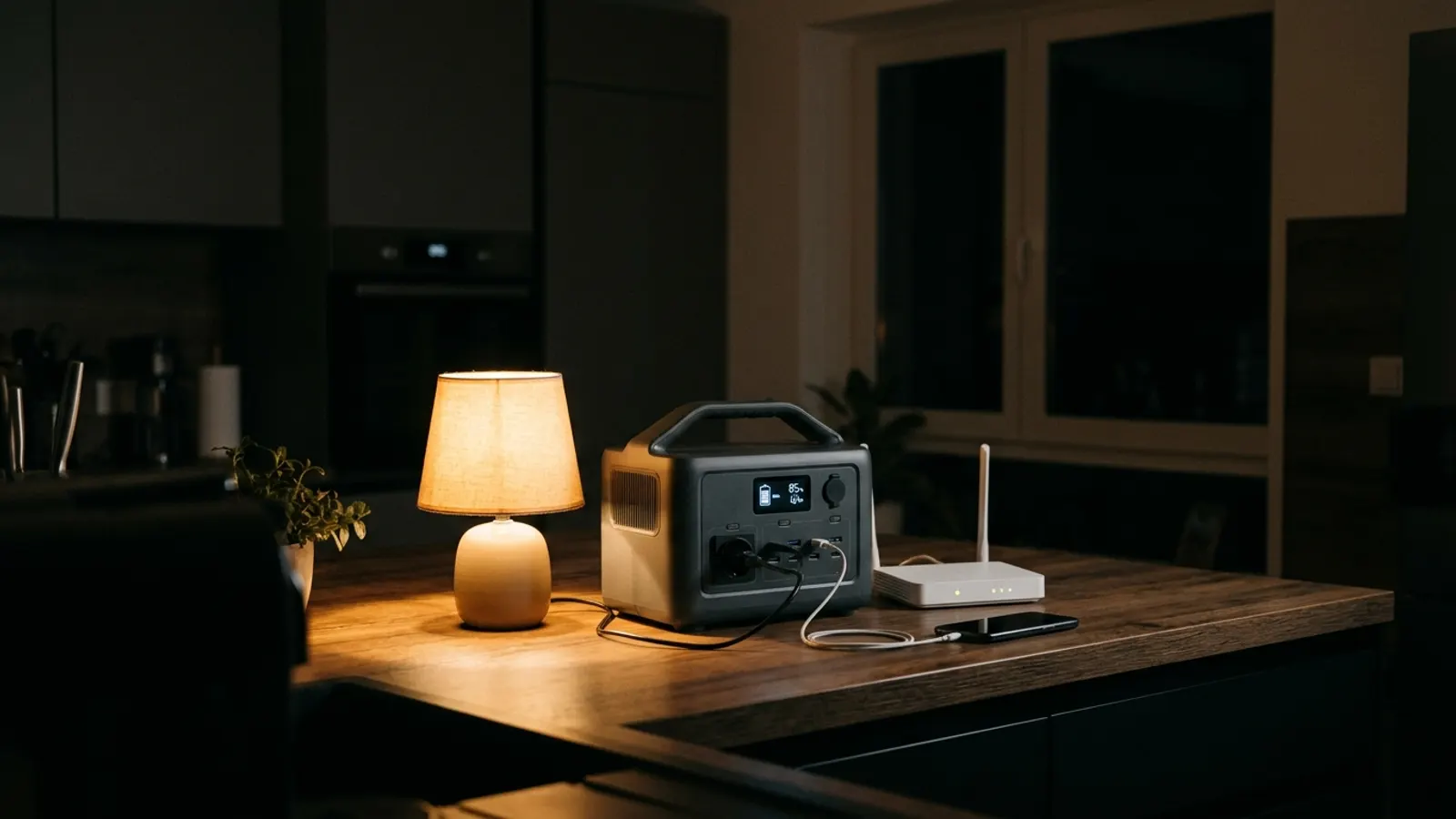
Every other device eats into your nights, so count it. We figure about 15 Wh per full phone charge. On the C1000, one phone charge a day plus 4 hours of an 8 W LED lamp adds 15 + 32 = 47 Wh a day.
Without the humidifier, the CPAP night is 176 Wh. Add the phone and lamp and a full day becomes 176 + 47 = 223 Wh. That turns about 5.1 nights into 898 ÷ 223 ≈ 4 nights. Still a solid margin for a typical outage.
Habits that help
- Keep the station charged and check it every month or two.
- Test it on a normal night at home, so you know your real numbers.
- Plug in only the CPAP overnight, and charge phones in the daytime.
For the rest of your outage plan, see our emergency kit page.
In short
- ResMed measured 7 Wh per hour for an AirSense 10 alone, and 34 Wh with full humidifier and heated tube.
- Without the humidifier, a 1,056 Wh station gives about 5 nights on its outlets.
- The humidifier roughly halves your nights, so ask your doctor if you can skip it for a few days.
- Confirm the right cable or converter with your equipment supplier before you count on it.
Sources
Questions
Can I run my CPAP from a power station's regular outlet?
Usually the machine's own power supply plugs in like at home. But ResMed warns that some older heated humidifiers must not be used with inverters, which is what a station's outlets are, so check with your equipment supplier.
Is it better to use the 12 V socket?
It can be. ResMed says its DC converters are more efficient than an inverter. You need the maker's DC cable or converter for your exact model, so ask your supplier.
How many nights do I get from a small 300 Wh station?
With a CPAP at 12 W and no humidifier on the regular outlet, about 1.4 nights. On a maker-approved 12 V converter, closer to 2.5 nights.
Should I tell my utility I use a CPAP?
Ask your utility whether it has a program for customers who rely on medical equipment. Also talk to your doctor about a power outage plan, as Ready.gov recommends.
Stations in this article
- 288 Wh · 300 W Jackery Explorer 300 Plus Every device with the Jackery Explorer 300 Plus288 Wh Check price
- 768 Wh · 800 W EcoFlow RIVER 2 Pro Every device with the EcoFlow RIVER 2 Pro768 Wh Check price
- 1056 Wh · 1800 W Anker SOLIX C1000 Every device with the Anker SOLIX C10001,056 Wh Check price
How much battery do you need?
Tick your devices and how long you need to last. The calculator gives you the answer in 30 seconds.
Open the calculator