Key takeaways
- A gas generator makes carbon monoxide and must run outdoors, more than 20 feet from windows, doors and vents, per the CDC.
- A power station makes no exhaust and can sit next to your bed, but it holds a fixed amount of energy.
- Energy from a small inverter generator costs roughly $0.70 to $1.10 per kWh in fuel at November 2026 gas prices, versus about $0.21 for a station charged from the grid.
- For long outages with big loads, a generator still wins; for quiet indoor power for a router, CPAP and phones, a station wins.
In this article
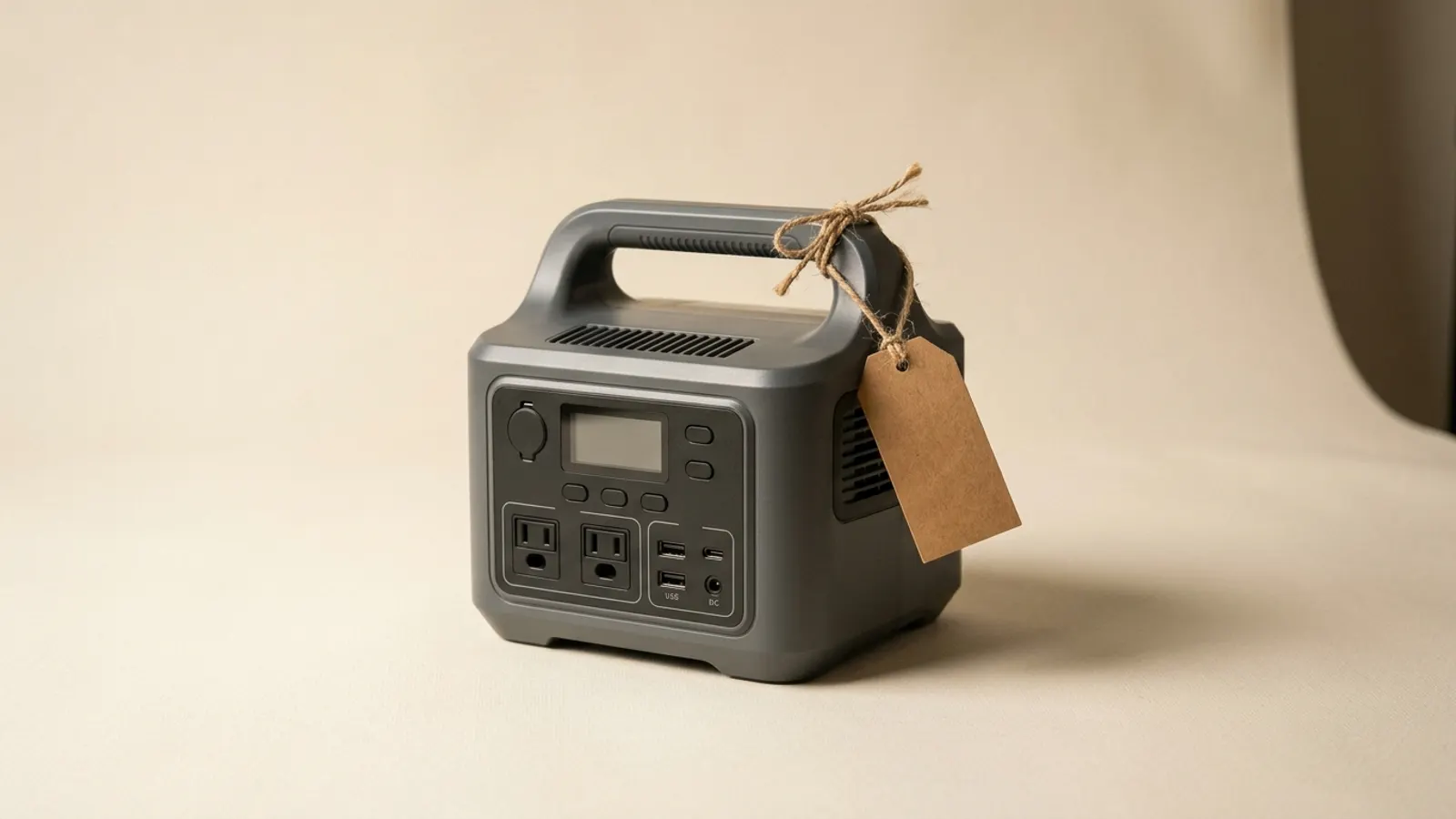
For most outages, the choice comes down to one trade. A gas generator gives you a lot of power for as long as you have fuel, but it makes carbon monoxide and noise and must stay outside. A power station is silent and safe indoors, but it only holds what you charged into it.
Carbon monoxide: the deciding safety issue
Carbon monoxide (CO) is a gas you cannot see or smell. Every gas engine makes it. The CDC says more than 400 Americans die each year from unintentional CO poisoning not linked to fires, and more than 100,000 visit an emergency room.
The CDC rules for generators are simple:
- Run it outdoors, more than 20 feet from windows, doors and vents.
- Never run it inside a home or garage, even with the doors and windows open.
- Put battery-powered or battery-backup CO alarms near every sleeping area.
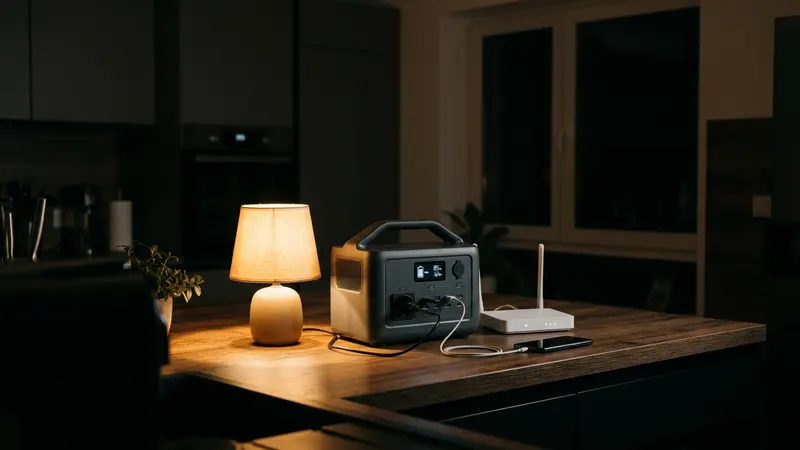
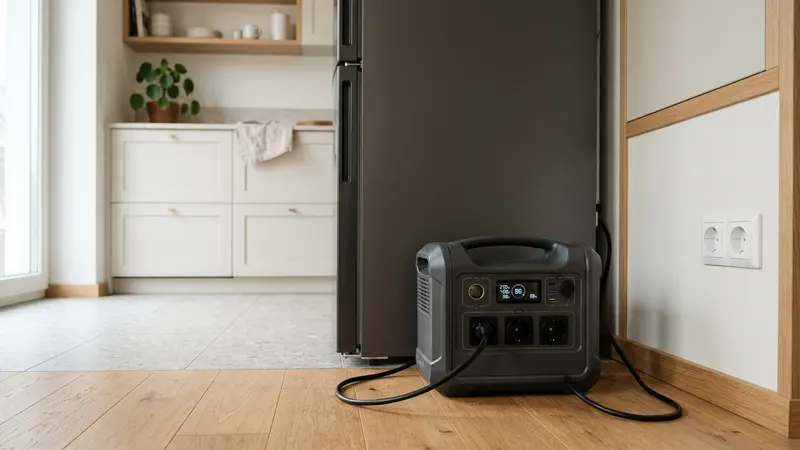
A power station burns nothing, so it makes no CO. You can set it beside a CPAP, on a desk or in a closet with the router. That is its biggest advantage, especially at night and in bad weather.
Noise and daily hassle
A small inverter generator is one of the quieter kinds. Honda’s EU2200i launch release gives 53 dB at quarter load and 62 dB at its rated load. That is quiet for a generator, but it is still an engine running outside your window, and neighbors will hear it at night.
A power station has no engine. Its cooling fans can spin up when it charges fast or runs a heavy load, but at low loads it is close to silent.
The hassle is different too. A generator needs fresh fuel, oil and someone to go outside and refill it. A station needs to be charged before the outage and recharged later from the wall, a car or solar panels.
Energy and cost per kWh
A kWh (kilowatt-hour) is 1,000 Wh: running 1,000 W for one hour. Honda announces that the EU2200i runs 3.2 hours at its rated 1,800 W, or 8.1 hours at quarter load (450 W), on its 0.95-gallon tank.
So one gallon gives:
- at full load: 1,800 W × 3.2 h ÷ 0.95 ≈ 6,060 Wh, about 6.1 kWh
- at quarter load: 450 W × 8.1 h ÷ 0.95 ≈ 3,840 Wh, about 3.8 kWh
The EIA put regular gas at $4.153 a gallon on November 2, 2026, and the average home electricity price at 18.16 cents per kWh in August 2026.
| Source of 1 kWh | Math | Fuel or power cost |
|---|---|---|
| Generator, full load | $4.153 ÷ 6.06 kWh | ≈ $0.69 |
| Generator, quarter load | $4.153 ÷ 3.84 kWh | ≈ $1.08 |
| Station charged from the grid | $0.1816 ÷ 0.85 | ≈ $0.21, a bit more with charging losses |
A generator wastes more fuel per kWh when you run small loads on it. Running a router and a fridge, you are well below quarter load, so each kWh probably costs even more than $1.08.
Cost of the box itself is another matter. To compare models, divide the price by the Wh: price ÷ Wh = cost per Wh of storage. We do not show a figure here because we have no dated US price for these models. Our comparison table lists capacity and output so you can do the math with today’s price.
How much each one can actually run
This is where the generator wins. Keep refilling it and it keeps going. A station runs only until its battery is empty.
On this site, runtime = battery Wh × 0.85 ÷ (device watts + 10 W), where 10 W is what the station uses with its outlets on.
| Load | FOSSiBOT F2400 (2,048 Wh, announced by the brand) | EcoFlow DELTA 3 Plus (1,024 Wh, announced by the brand) |
|---|---|---|
| Fridge, 45 W average | 2,048 × 0.85 ÷ 55 ≈ 32 h | 1,024 × 0.85 ÷ 55 ≈ 16 h |
| Router, 10 W | 2,048 × 0.85 ÷ 20 ≈ 87 h | 1,024 × 0.85 ÷ 20 ≈ 44 h |
| 1,800 W load | 2,048 × 0.85 ÷ 1,810 ≈ 1 h | above its 1,800 W output |
The EU2200i, by contrast, carries an 1,800 W load for 3.2 hours per tank, and you can refill it. For a well pump, a window air conditioner or power tools, a generator fits better.
For a fridge, a router and phones, a station is plenty for a day or two. Check your own devices in the runtime calculator.
Which one to pick
Pick a power station if
- you live in an apartment or a home with no safe spot 20 feet from openings;
- you mainly need internet, phones, lights, a fan or a CPAP;
- you want silent power at night.
Pick a gas generator if
- outages in your area often last several days;
- you need to run large loads or tools;
- you have a safe outdoor spot, fresh fuel and CO alarms in place.
Many households use both: the generator outdoors in daytime to recharge the station, and the station indoors at night. Never connect either one to a wall outlet or to your home’s wiring; a transfer switch must be installed by a licensed electrician. To size a station for your home, start with the FOSSiBOT F2400 page.
In short
- A generator must run outdoors, more than 20 feet from openings; a station can stay inside.
- Fuel energy from a small inverter generator costs about $0.70 to $1.10 per kWh at current gas prices.
- A station charged from the grid costs about $0.21 per usable kWh, but holds a fixed amount.
- Use a station for quiet, small loads and a generator for big loads over many days.
Sources
- CDC: Carbon monoxide poisoning basics (deaths, generator distance, CO alarms)
- Honda Power Equipment: EU2200i press release (output, run time, tank, sound level)
- U.S. EIA: Gasoline and diesel fuel update (regular gas, Nov. 2, 2026)
- U.S. EIA: Electric Power Monthly, table 5.6.A (residential price, Aug. 2026)
Questions
Can I run a gas generator in my garage with the door open?
No. The CDC says never to run a generator inside a home or garage, even with doors and windows open. Run it outdoors, more than 20 feet from windows, doors and vents.
Is a power station safe to use indoors?
It burns no fuel, so it makes no carbon monoxide. Keep it dry, give its fans room to breathe and follow the maker's manual.
Can a power station replace a generator for a whole house?
Not for a whole house. A 2,000 Wh station runs an 1,800 W load for about an hour. It is made for small, steady loads over many hours.
Can I use both?
Yes. Some people run a generator outdoors in daytime to recharge the station, then turn the generator off at night and use the quiet station inside.
Stations in this article
- 2048 Wh · 2400 W FOSSiBOT F2400 Every device with the FOSSiBOT F24002,048 Wh Check price
- 1024 Wh · 1800 W EcoFlow DELTA 3 Plus Every device with the EcoFlow DELTA 3 Plus1,024 Wh Check price
- 1056 Wh · 1800 W Anker SOLIX C1000 Every device with the Anker SOLIX C10001,056 Wh Check price
How much battery do you need?
Tick your devices and how long you need to last. The calculator gives you the answer in 30 seconds.
Open the calculator