Key takeaways
- Lights and phones alone use about 125 Wh a day, so a 300 Wh station covers a tent weekend.
- An electric cooler is the big user: count about 360 Wh a day, which pushes you toward 750 to 1,000 Wh.
- A fan on warm nights adds about 400 Wh a night on the outlets, enough to empty a 1,000 Wh station in about a day with the cooler.
- A 200 W solar panel adds roughly 0.8 to 1 kWh a day on paper in early summer in the Smokies, less in shade.
In this article
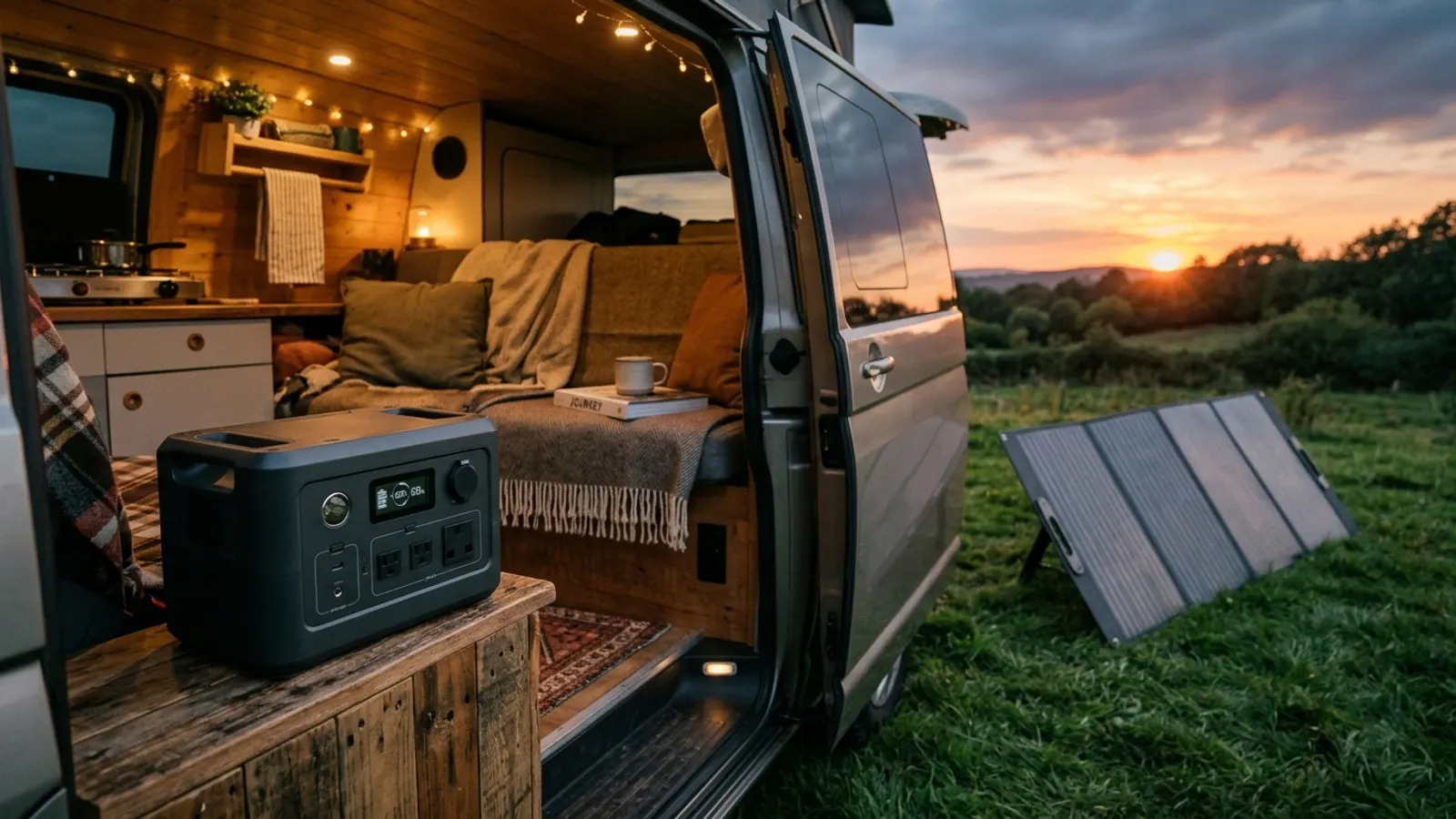
For a tent weekend with just lights and phones, a small 300 Wh station is enough. Bring an electric cooler and you need about three times more, which points to a station of 750 to 1,000 Wh. In an RV with a fan on warm nights, aim for 1,000 Wh or more, plus a solar panel.
Start with what you will plug in
Camping power is mostly small stuff. The big question is whether you bring an electric cooler, and whether you want a fan at night.
Our site averages and one maker’s measured figure:
- LED lamp: 8 W
- phone charging: 10 W for about 3 hours
- fan: 40 W
- 12 V compressor cooler: Dometic measured 0.98 Ah per hour at 12 V for its CFX3 35 with 90°F outside, which is 0.98 × 12 ≈ 12 W on average. We count 15 W to leave a margin for opening the lid and hot afternoons.
Daily watt-hours for three setups
Watt-hours (Wh) per day = watts × hours of use. Here is the math for two people.
| Item | Use | Wh per day |
|---|---|---|
| 2 LED lamps | 8 W × 4 h × 2 | 64 |
| 2 phones | 10 W × 3 h × 2 | 60 |
| 12 V cooler | 15 W × 24 h | 360 |
| Fan on the outlet, warm nights | (40 W + 10 W) × 8 h | 400 |
The cooler runs from the 12 V socket and lamps and phones from USB, so the station’s outlets stay off. We only add the station’s own 10 W to the fan, which plugs into an outlet.
That gives three typical setups:
- Tent, basics: 64 + 60 = 124 Wh a day
- Tent or RV with cooler: 124 + 360 = 484 Wh a day
- RV with cooler and a fan at night: 484 + 400 = 884 Wh a day
Which size covers the weekend
Usable energy is about 85 % of the battery, since some is lost along the way. Days = battery Wh × 0.85 ÷ Wh per day.
| Station (capacity announced by the brand) | Usable Wh | Basics, 124 Wh/day | With cooler, 484 Wh/day | Cooler + fan, 884 Wh/day |
|---|---|---|---|---|
| Jackery Explorer 300 Plus (288 Wh) | ≈ 245 | ≈ 2 days | ≈ 0.5 day | ≈ 0.3 day |
| EcoFlow RIVER 2 Pro (768 Wh) | ≈ 653 | ≈ 5.3 days | ≈ 1.3 days | ≈ 0.7 day |
| Jackery Explorer 1000 v2 (1,070 Wh) | ≈ 910 | ≈ 7.3 days | ≈ 1.9 days | ≈ 1 day |
Example: for the RIVER 2 Pro with a cooler, 768 × 0.85 ≈ 653 Wh, and 653 ÷ 484 ≈ 1.3 days.
A Friday evening to Sunday afternoon trip is about two days. So the 300 Plus covers a basics weekend, the 1000 v2 nearly covers a cooler weekend, and the fan setup needs solar or a recharge. Try your own list in the runtime calculator.
Ways to make the battery go further
Small habits matter more than the station’s size:
- Pre-chill the cooler and its food at home on house power the night before. A warm cooler runs its motor much longer on day one.
- Park the cooler in the shade and open it as little as you can.
- Charge phones in the car while driving to the site.
- Turn off the station’s outlets when nothing is plugged in. That saves the 10 W it uses on its own, or 240 Wh a day.
- Use a lamp with its own battery and recharge it in the afternoon.
Weight and what it means at camp
Weight matters when you carry it from the car to the site. As announced by the brands:
- Jackery Explorer 300 Plus: 3.75 kg, about 8.3 lb
- EcoFlow RIVER 2 Pro: 7.8 kg, about 17.2 lb
- Jackery Explorer 1000 v2: 10.8 kg, about 23.8 lb
For a walk-in tent site, the small one is easy to carry. For car camping or an RV, the bigger ones sit in one spot all weekend, so weight matters less.
In an RV, set the station on the floor and strap it so it cannot slide while driving. Do not wire it into the RV’s electrical system yourself; anything fixed in the vehicle is a job for a qualified RV technician.
Adding a solar panel
A solar panel can keep you going past two days. PVGIS, a European Commission solar tool, gives about 4.8 kWh per day in June and 4.3 kWh in July for each 1,000 W of flat panels near Gatlinburg, Tennessee. Those are monthly averages that include cloudy days.
On paper, a 200 W panel then makes 0.2 × 4.8 ≈ 0.95 kWh a day in June. Real output is lower than the panel’s watts suggest: tree cover at a campsite, heat and a poor angle all cut into it. Moving the panel to follow the sun helps.
Check how much solar the station accepts: the brands announce 220 W for the RIVER 2 Pro and 400 W for the Jackery 1000 v2. Our comparison of stations lists solar input for each model.
Even half of that 0.95 kWh would cover the cooler setup’s 484 Wh a day. For the full RV setup at 884 Wh, you would want a bigger panel or a station like the Jackery Explorer 1000 v2 plus a drive-time top-up.
In short
- Lights and phones need about 125 Wh a day; a 300 Wh station covers a tent weekend.
- An electric cooler adds about 360 Wh a day, so plan on 750 to 1,000 Wh.
- A fan on warm nights adds about 400 Wh a night on the outlets and calls for solar.
- A 200 W panel gives roughly 1 kWh a day on paper in June, less under trees.
Sources
Questions
Can a power station run an RV air conditioner?
Not for long, if at all. Rooftop RV air conditioners are far bigger loads than the devices in this guide. Use shore power or a generator at the campground for that.
Do I need a power station if my campsite has hookups?
Not really. With an electric hookup, the station is mostly useful away from the RV, at the picnic table or in the tent.
Can I charge the station while driving?
Most stations accept charge from the car's 12 V socket. It is slow, so treat it as a top-up, not a full recharge.
Is it safe to keep the station inside the tent?
It makes no exhaust, so yes, as long as it stays dry, off the wet ground and has room for its fans to breathe.
Stations in this article
- 288 Wh · 300 W Jackery Explorer 300 Plus Every device with the Jackery Explorer 300 Plus288 Wh Check price
- 768 Wh · 800 W EcoFlow RIVER 2 Pro Every device with the EcoFlow RIVER 2 Pro768 Wh Check price
- 1070 Wh · 1500 W Jackery Explorer 1000 v2 Every device with the Jackery Explorer 1000 v21,070 Wh Check price
How much battery do you need?
Tick your devices and how long you need to last. The calculator gives you the answer in 30 seconds.
Open the calculator